Broccoli, Kale, Cabbage, and More: Six Vegetables That All Came From One Wild Plant
Broccoli, cauliflower, cabbage, kale, Brussels sprouts, and kohlrabi are all the same species. Here is how farmers turned a wild seaside plant into six very different vegetables.
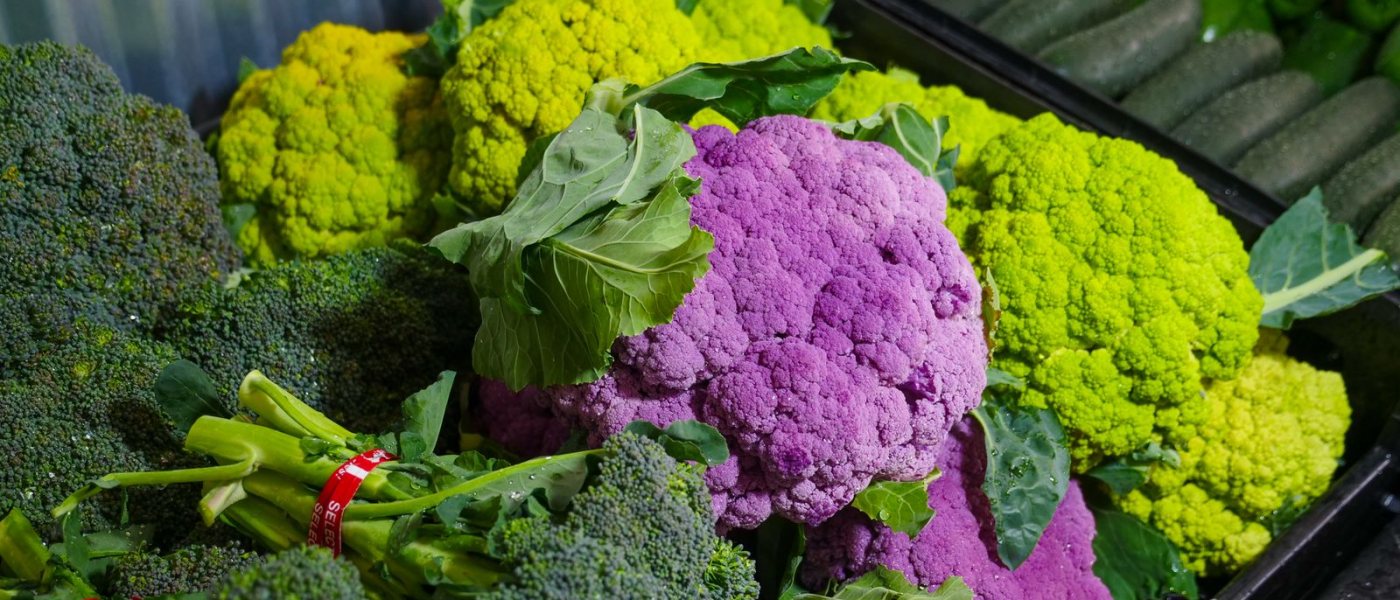
Broccoli, cauliflower, cabbage, kale, Brussels sprouts, and kohlrabi look nothing alike. One is a head of tiny green trees, one a ball of white curds, one a stack of crinkled leaves. Yet they all belong to the same species, and they all came from one scraggly wild plant that grows on seaside cliffs. Here is how farmers turned a bitter weed into six vegetables.
1) The Ancestor Is Wild Cabbage, a Plant of Europe's Atlantic Coast
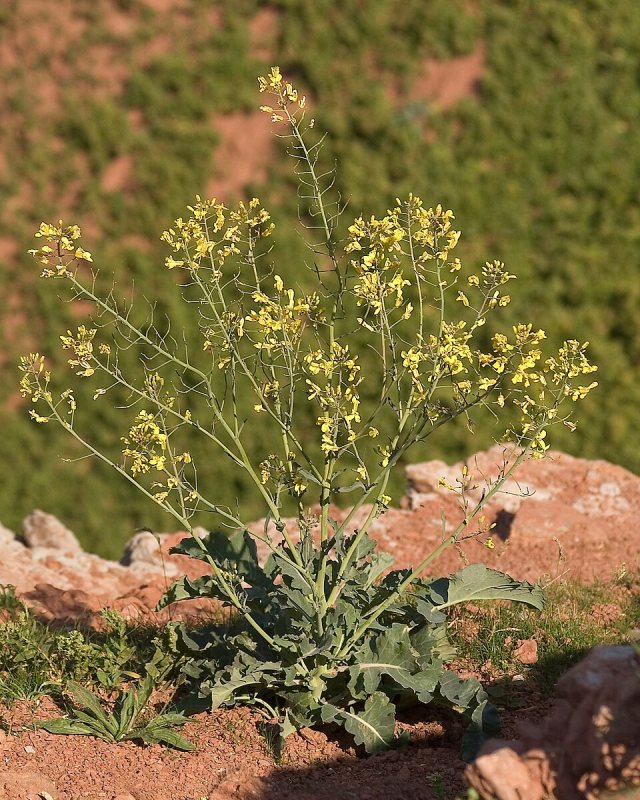
You may have heard that these vegetables came from wild mustard. The true ancestor is wild cabbage (Brassica oleracea), a close relative that belongs to the mustard family. It is a plant of Europe's Atlantic coast. According to Kew's Plants of the World Online, its native range is the Atlantic coasts of Great Britain, France, and Spain, and it grows on limestone and chalk sea cliffs, including the cliffs around Dover in England and in Normandy in France. A 2022 study describes wild plants along the Atlantic and Mediterranean coasts, with the wild samples in its study collected mainly in the United Kingdom. According to the Laidback Gardener, wild cabbage tolerates salt spray and limy soil. In its first year it forms a low rosette of leaves. In its second year it sends up a flower stalk that can reach about seven feet tall, covered in yellow flowers, and then it dies after setting seed.
Even the word "wild" needs a caveat. Researchers distinguish wild, domesticated, and feral populations, which are plants that escaped from farms and gardens, and some coastal populations that were once assumed to be wild may be escapes. Where the crops were first domesticated is also debated. The closest living wild relative is Brassica cretica, native to Greece and the Aegean islands, according to a 2021 study described in the 2022 paper above. That is a clue that the story may have started in the Mediterranean as well as on Europe's Atlantic cliffs.
2) Farmers Selected Different Parts of the Plant
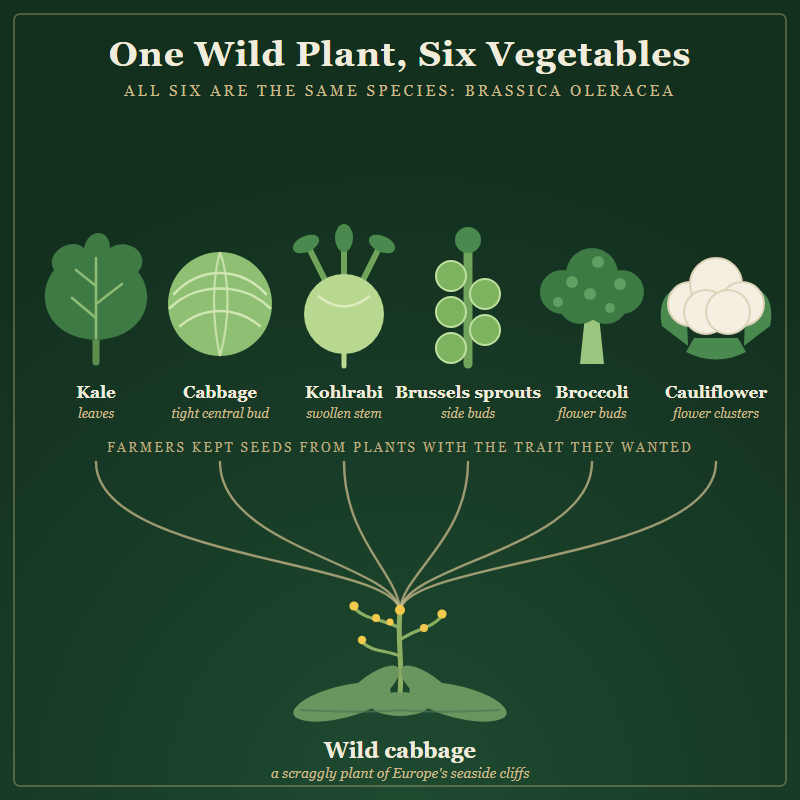
Nobody invented these vegetables in a lab. Over many centuries, farmers kept seeds from plants they liked and planted them again, and each choice pushed the plant in a new direction. Researchers describe Brassica oleracea as a model for how strongly selection by people can reshape a species, and Charles Darwin drew parallels between this kind of cultivation and natural selection, as a 2021 paper on the plant's evolutionary history notes. Here is which part of the plant each vegetable came from:
- Kale: farmers selected for larger, more tender leaves. Genetic studies point to kale as the crop most closely related to wild cabbage.
- Cabbage: breeders picked plants whose leaves wrapped tightly around a central bud, making a dense head.
- Kohlrabi: the stem, just above the soil, was selected to swell into a bulb.
- Brussels sprouts: farmers favored plants that produced small buds along a tall stem, creating a row of miniature cabbages.
- Broccoli: the flower buds were selected to form large green clusters, and they are harvested before the flowers open.
- Cauliflower: the flower stalks were selected to form dense white curds, picked at the beginning of flowering.
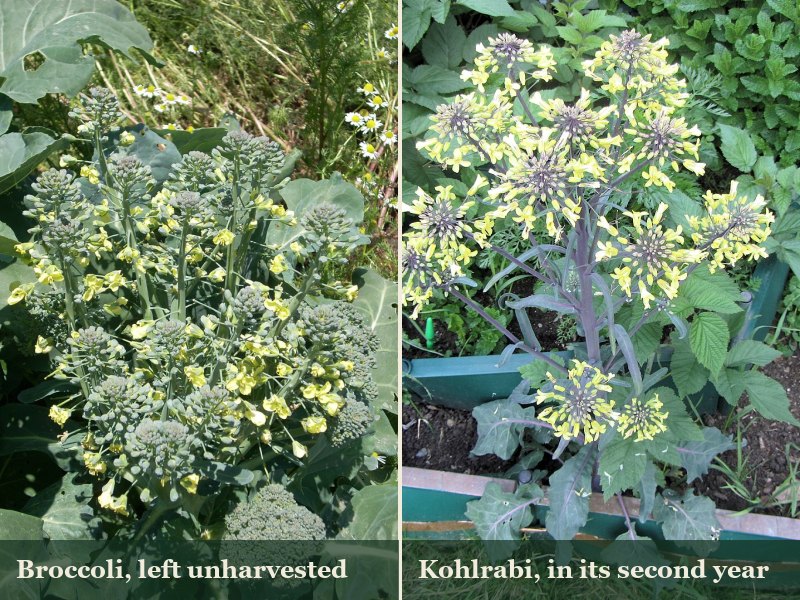
You can see the family resemblance in a garden. Broccoli is harvested while its buds are still tightly closed, but if you leave it too long, the buds open into small yellow flowers. They look just like the flowers that open on kohlrabi, kale, cabbage, and the other varieties when they are left to go to seed in their second year, and they match the yellow blossoms of wild cabbage on the cliffs. The vegetables you buy are really these plants caught before they flower.
3) When It Happened: A Long, Gradual Story
There is no single date when these vegetables were invented. The Laidback Gardener notes that kale was among the earliest forms, and that head cabbage was known to the ancient Romans. Dense-flowered types like cauliflower and broccoli took shape much later, in the Middle Ages and the centuries after, and Brussels sprouts developed in the Low Countries. Sources differ on exact dates, and the process was slow, with farmers across Europe and the Mediterranean making their own selections.
4) Scientists Still Debate Where It Began
Where wild cabbage was first domesticated is still debated. Hypotheses range from a single domestication in one place to several separate ones. A 2022 study of 224 samples of the crop argued that cabbage-family crops may have a Middle Eastern origin, while other researchers point to wild populations in Western Europe. Either way, the genetic evidence confirms that these vegetables are one species.
5) Its Cousins in the Mustard Family
Wild cabbage is one member of a larger family of crops. Other close relatives in the same genus include turnips, bok choy, and napa cabbage (Brassica rapa), mustard greens and mustard seed (Brassica juncea, along with black mustard, Brassica nigra), and rutabaga and canola (Brassica napus). In the 1930s, a Korean botanist working in Japan, known as Nagaharu U, worked out how these species are related, a relationship called the Triangle of U. Researchers have since confirmed it with DNA, as described in a 2022 genome paper. In other words, the mustard in your pantry and the cabbage in your crisper drawer are cousins.
6) What It Means at the Grocery Store
Here is a fun way to see it for yourself. If you buy seeds for these vegetables, check the botanical name on the back of each packet. Kale, cabbage, broccoli, cauliflower, Brussels sprouts, and kohlrabi are all listed as Brassica oleracea. Technically, you are buying the same species six times, just selected over the centuries for different traits. It also means they can cross-pollinate if they flower near each other, which is why gardeners who save seed keep them apart.
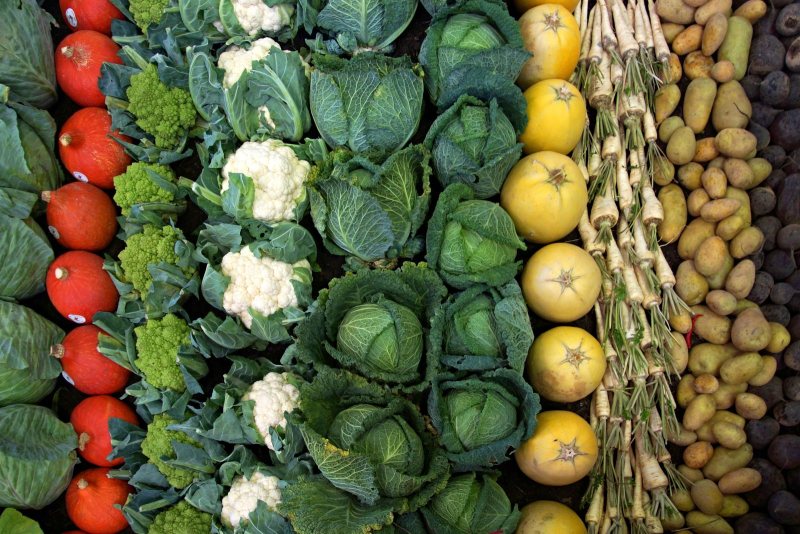
Knowing the family tree is a little like having a cheat sheet for the produce aisle. Because these vegetables share a species, they share traits: they are hardy, they grow well in cool weather, and they tend to be inexpensive, especially cabbage, which is among the cheapest vegetables you can buy. A few ways to use the whole family:
- Swap them in recipes. Cabbage, kale, and Brussels sprouts all roast, sauté, and braise well, and broccoli and cauliflower can often stand in for each other.
- Use the stems. Broccoli stems are much like kohlrabi in taste and texture. Peel them and slice them into stir-fries or slaws.
- Buy frozen or in season. Frozen broccoli and cauliflower are inexpensive, last for months, and keep their nutrition.
- Grow your own. The whole family does well in cool spring and fall gardens, and one packet of seeds goes a long way.
Planning a One-Plant Dinner? Finding Kohlrabi Is the Hard Part
It is a fun idea: roast cabbage wedges, cauliflower, and Brussels sprouts, add a pan of broccoli and some sautéed kale, and call it a dinner made from one plant. Kohlrabi is the one that can be tricky to find, and we have had trouble finding it at regular grocery stores ourselves. Here is what we have learned.
- The name is German, even if it sounds Asian. Kohlrabi comes from the German words for cabbage (Kohl) and turnip (Rübe, or Rabi in Swiss German), because the swollen stem looks like a turnip, according to the dictionary entry, which traces the word through German to Italian cavolo rapa. It is common in Germany and Central Europe, and it has a following in parts of Asia too, including Kashmir, where it goes by names such as ganth ghobi.
- Try Asian and international grocers. They are said to carry it, and an Asian American grocery site lists it. It will not be at every store, so call ahead.
- Look at farmers markets and CSA boxes. Kohlrabi is a cool-weather crop, so spring and fall are the best times. Michigan State University Extension notes that most harvests finish before November, although stored kohlrabi keeps into the winter.
- Ask your produce manager. Some supermarkets carry it seasonally, and many will order it if you ask.
- Grow your own. It is a quick, easy crop for cool weather, and seed is widely sold. It is also the best way to see the family tree for yourself, because the plant will flower just like its cousins.
The Bottom Line
The next time you see broccoli next to cauliflower, remember that they are the same plant, shaped by hundreds of years of farmers choosing what they liked best. It is one of the clearest examples of how people have changed the food we eat, and it started with a scraggly seaside weed.
Wild cabbage photo (Helgoland, Germany): Kulac, via Wikimedia Commons, CC BY-SA 3.0, resized. Broccoli flowers photo: Jengod, via Wikimedia Commons, CC BY-SA. Kohlrabi flowers photo: Flexmaen, via Wikimedia Commons, CC BY-SA 4.0. The two flower photos were cropped and combined, with labels added. Other photos from Pexels.