When Ketchup Was Sold as Medicine
Tomatoes were once feared as poison, then hyped as a cure. Follow ketchup from Chinese fish sauce to 1830s tomato pills to the Heinz bottle.

Ketchup seems like the least mysterious thing on the table. Yet in the 1830s, Americans could buy tomato catsup and tomato pills as cures for indigestion and liver trouble, only a few decades after many of their grandparents feared tomatoes as poison. Ketchup really was sold as medicine for a while. Here is how the tomato went from suspect to cure-all to the most popular condiment in America.
Why Were Tomatoes Once Feared as Poison?
Tomatoes got a mixed welcome when they reached Europe. The Italian herbalist Pietro Andrea Mattioli described the tomato in 1544 and grouped it with the nightshades. That plant family includes eggplants and potatoes, but also one specific species called deadly nightshade, a notoriously poisonous European plant with small, round, shiny berries much like a little tomato. Italians were already cooking tomatoes much like eggplants, but farther north the doubts stuck. The confusion made some sense, since tomato leaves and stems really are toxic, though the ripe fruit is not.

The English barber-surgeon John Gerard sealed the tomato's fate in Britain with his 1597 Herbal, which called the whole plant rank and stinking. His opinion held in Britain and the American colonies for about 200 years. A popular story blames lead from pewter plates for sickening wealthy tomato eaters, but a simpler explanation is more likely: small tomatoes grow in clusters much like the berries of deadly nightshade, so herbalists assumed they were poisonous too.
Tomatoes slowly won Americans over in the early 1800s. Tomato recipes were showing up in newspapers by the 1820s, even though many Americans had considered tomatoes poisonous or unappealing until then.
Where Did Ketchup Come From?
Ketchup started as a fermented fish sauce in China, with no tomatoes in it at all. British sailors bought the sauce, called ke-tsiap or ke-tchup by 17th-century Chinese and Indonesian traders, to liven up their hardtack and salt pork. Back home in England, cooks tried to recreate it with whatever was on hand, so early ketchups were made from all sorts of ingredients.
- Fish brinethe original Asian sauce
- Mushroomsan English favorite
- Walnutspickled green walnuts
- Anchoviesfor a salty kick
- Shallotsin place of fish
- Elderflowera floral twist
Tomato ketchup came along in the early 1800s. Philadelphia scientist James Mease published a ketchup recipe made with tomatoes, brandy, mace, allspice, and salt in 1812, one of the first tomato ketchups in print. A British recipe from 1817 called for "a gallon of fine, red, and full ripe tomatas" along with anchovies and shallots, but Americans were the ones who made tomato ketchup their own.
Was Ketchup Really Sold as Medicine?
Ketchup really was promoted as medicine in the 1830s, and the man behind it was Dr. John Cook Bennett of Ohio. In a lecture at Willoughby University, Bennett claimed tomatoes could treat diarrhea, indigestion, and "bilious attacks," and he urged people to eat them in catsup. He published recipes for tomato sauce, fried tomatoes, tomato pickles, and tomato catsup to spread the word.
Tomatoes looked appealing to doctors of the era for a practical reason. Many physicians relied on calomel, a harsh mercury compound used as a purgative, and some promoted concentrated tomato products as a gentler replacement. English doctors had already been prescribing tomatoes for digestive and liver complaints since the mid-1700s.
Bennett was a colorful character. He later moved to Illinois, joined the Mormon community in Nauvoo, and became close to Joseph Smith before being excommunicated in 1842, yet he kept writing about tomatoes for decades.
The Great Tomato Pill Craze
Tomato pills took the tomato cure to its peak. By the late 1830s, sellers such as Archibald Miles of Cleveland and the Yale-educated doctor Guy R. Phelps were advertising pills made from "extract of tomato." Hundreds of thousands of people bought tomato pills, and the craze lasted until about 1850.
Not every doctor bought the hype. William Darlington, a physician and botanist, called tomato cure-alls "a means of levying an additional tax upon the credulous". By 1865, the magazine American Agriculturist was simply urging readers to enjoy tomatoes without worrying about any resemblance to calomel.
Ketchup's run from poison to medicine to everyday food took about three centuries, and this timeline marks the turning points.
- 1544Mattioli groups the tomato with the nightshades
- 1597Gerard's Herbal calls the plant rank and stinking
- 1812James Mease prints a tomato ketchup recipe
- 1830sDr. John Cook Bennett touts tomato catsup as medicine
- Late 1830stomato pills sweep the country
- 1876Heinz adds tomato catsup to its line
- 1906the Pure Food and Drug Act becomes law
How Heinz Made Ketchup a Pantry Staple
Ketchup became an everyday condiment once companies started bottling it. The H.J. Heinz Company, which began with horseradish, sauerkraut, vinegar, and pickles, added catsup to its line in 1876 and later switched the spelling to "ketchup". Early bottled ketchups spoiled quickly, so makers added extra vinegar and then sugar to balance it, which is how ketchup got its sweet and tangy flavor.
Henry J. Heinz also bet on cleanliness. He packed ketchup in clear glass so shoppers could see what they were buying, opened his Pittsburgh factory to public tours, and around 1900 developed a thicker, tomato-rich ketchup with no chemical preservatives. Heinz backed the food safety push that led to the Pure Food and Drug Act of 1906.
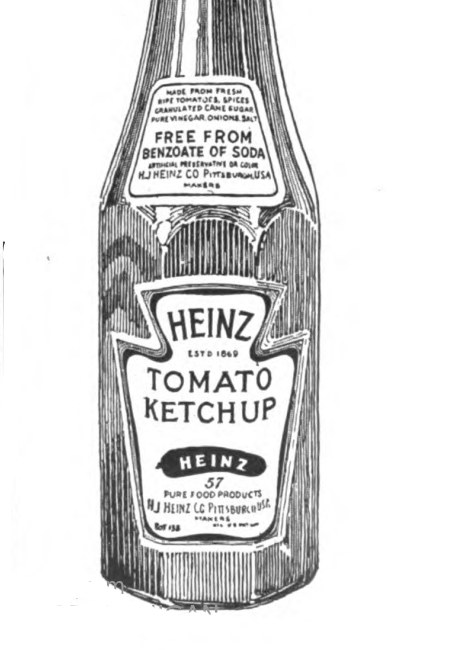
Heinz was selling 5 million bottles of ketchup a year by the early 1900s, and ketchup now sits in almost every American kitchen. These tiles show how much ketchup Americans go through.
Ketchup Earned Its Place on Flavor
Ketchup's medicine days are long gone, but the tomato came out a winner. The fruit people once feared became one of the most beloved foods in the world, and ketchup earned its spot on the table by tasting good on fries, burgers, and eggs. For the full story, food historian Andrew F. Smith wrote a whole book on ketchup's past.
For more food history, read about the graham cracker's health food past, why today's root beer isn't like the original, how Spam became a pop culture icon, and whether tomatoes belong in the refrigerator.
Header photo of tomato sauce by Dennis Klein on Unsplash, tomato plant photo by Famartin (CC BY-SA 4.0), and 1923 Heinz ad from Life (public domain), via Wikimedia Commons.